How Long Does a 10 kWh Home Battery Run During a Blackout? 5 Essential Circuits Ranked
Real watt-hour calculations explaining usable battery kWh, inverter standby drain, AS/NZS 4777 EPS switching, and exactly how long a 10 kWh solar battery runs during a grid outage.
Signing off on a A$10,000–A$14,000 residential battery installation assuming your whole house will sail through multi-day blackouts effortlessly is a surprisingly common Australian disappointment. Plenty of battery owners only discover the truth during their first stormy evening outage: either their quote excluded a backup gateway entirely, or forgetting a heated bathroom towel rail and hot-water element flattened the battery by midnight. Working out realistic home battery blackout runtime starts by stripping away glossy brochure capacity to measure usable kilowatt-hours, inverter overhead and actual circuit draw.
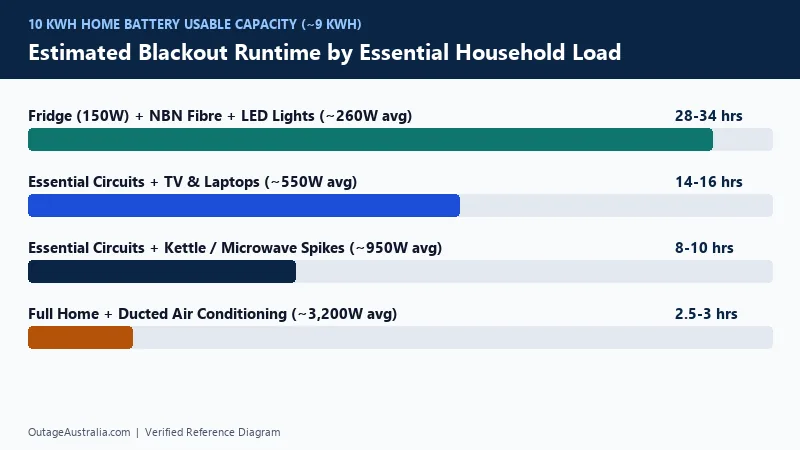
Why a "10 kWh" Battery Only Delivers ~8.5 kWh at Your Sockets
Three unavoidable technical losses sit between a battery's marketing label and your wall powerpoints:
- Depth of Discharge (DoD) Protection Reserve: Modern LFP and lithium-ion residential packs typically protect 5–10% bottom cell reserve to avoid chemical wear—leaving roughly 9.0 to 9.5 kWh usable on a nominal 10 kWh unit.
- Inverter Conversion & Standby Overhead: Converting DC battery storage to clean 240V AC power, plus running the hybrid inverter's internal control relays (typically 40–70W nonstop), consumes another 8–10%—reducing net delivered energy to roughly 8.2–8.8 kWh.
- Your Evening Tariff Reserve Setting: Most households configure batteries to self-consume stored solar down to 10% every night between 5 PM and 9 PM. Unless you set a 20–30% Blackout Reserve inside your battery app ahead of severe storm alerts, an unexpected midnight outage could catch your battery nearly empty.
Test your exact household appliance combinations with our interactive Solar & Home Battery Backup Calculator.
5 Essential Household Circuits Ranked From Longest to Shortest Runtime
When licensed Clean Energy Council electricians wire backup circuits under Australian battery safety standards, watt-hour demand splits sharply across household loads:
| Circuit / Appliance Group | Typical Load Draw | 24-Hour Energy Use | Estimated Runtime on 8.5 kWh Usable |
|---|---|---|---|
| 1. NBN NTD + Wi-Fi Router + Phone Chargers | 25–45W continuous | 0.7–1.0 kWh/day | Days (paired with fridge) |
| 2. Modern Inverter Fridge + Chest Freezer | 100–160W cycling (~60W avg) | 1.3–1.8 kWh/day | ~30+ hours combined with NBN & LED lights |
| 3. LED Downlights + Two Ceiling Fans | 80–130W evening use | 0.8–1.2 kWh/evening | ~20–24 hours alongside fridge/Wi-Fi |
| 4. Instant Gas Hot Water Igniter + Microwave Brief Use | 50W igniter + 1,200W bursts (3 mins) | ~0.4 kWh/day | Negligible impact if used briefly |
| 5. Split-System AC (7 kW) or Electric Hot Water Tank | 2,000–3,600W continuous | Exhausts reserve rapidly | 2.3 – 4 hours total before full shutdown |
Whole-Home Backup vs Dedicated Essential Circuits Sub-Board
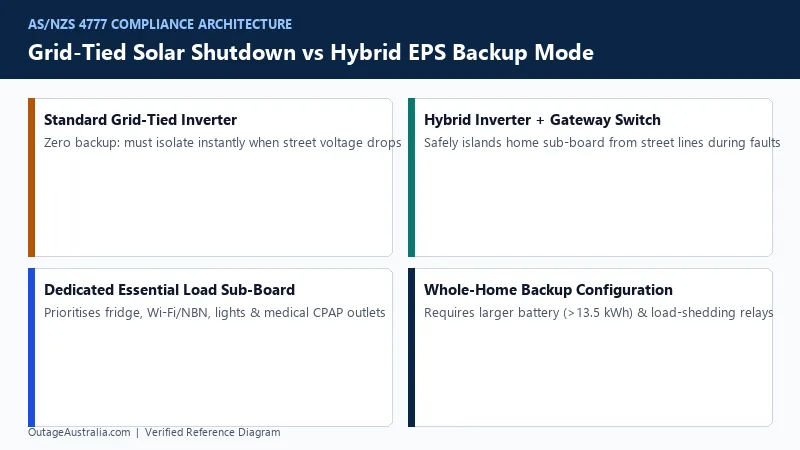
Installers routinely pitch two wiring designs: whole-home backup versus a dedicated essential circuits sub-board. Even though whole-home changeover sounds simpler on paper, tying every outlet in a four-bedroom house onto a standard 5 kW single-phase hybrid inverter introduces a classic blackout trap: boiling a 2,200W kettle while an electric hot-water pump or oven cycles on trips the inverter's 5,000W overload protection instantly in the dark.
Dedicated essential sub-boards avoid nuisance trips cleanly by backing up only your fridge socket, NBN/router circuit, main lighting circuit, garage door motor and gas hot-water igniter. High-draw resistive loads—induction cooktops, ducted air conditioning, pool pumps and 7 kW EV chargers—remain safely unpowered on the main grid rail until utility supply returns.
Daytime Solar Recharging & "Storm Watch" Modes
If an extended bushfire or cyclone outage drags past 24 hours, true hybrid inverters with black-start capability disconnect from the street line safely and use your rooftop solar panels to refill the battery every morning while running daytime circuits. Watch out for two field caveats: AC-coupled older solar inverters often exceed hybrid battery frequency-shift ratios if oversized, forcing daytime curtailment; and if a battery drains all the way to 0% overnight in overcast weather, certain units need bright midday sun or a manual DC restart button push to wake up.
Worked Calculation: 10 kWh Battery Stretching Through a 24-Hour Storm Outage
Before storm warnings hit your region, switch on Storm Watch (or manually push backup reserve to 80–100%) inside your inverter app so grid or morning solar holds full backup before wind arrives. Look at a realistic worked evening scenario: starting a 7 PM winter blackout at 90% charge (~8.0 kWh delivered AC power), running your fridge (65W avg), FTTP NBN router (30W), two living-room LED downlights (20W) and charging two phones overnight draws roughly 125W per hour—barely 1.5 kWh over 12 overnight hours, leaving 6.5 kWh spare at dawn for rooftop solar to recharge the pack cleanly even under hazy winter cloud. Compare electricity tariff payback alongside historical outage counts in our Electricity kWh Tariff Calculator and permanent outage archive.
If an extended heatwave hits while your battery sits at 50% capacity and you switch on a large ducted AC drawing 3,200W, that remaining ~4.3 kWh vanishes in roughly 80 minutes—leaving the fridge dark by bedtime. Discipline over high-draw heating and cooling loads—switching off electric hot water elements, pool pumps and heated floors at the breaker board—is what separates multi-day autonomy from premature shutdowns.
Frequently Asked Questions
Do all home solar batteries automatically provide blackout backup?
No. Many standard installations lack an automatic EPS changeover switch or backup gateway—if backup wasn't specified in your quote, the battery shuts off alongside street power under AS/NZS 4777 rules. Always request a live grid-isolation test on commissioning day by flicking off the main switchboard isolator while your solar installer is on site.
Can I run a bedroom split-system air conditioner overnight off a 10 kWh battery?
A small 2.5 kW bedroom inverter split running gently on eco/sleep mode draws roughly 350–600W once cooled, consuming ~3.5–4.5 kWh over 8 hours—viable overnight only if the battery starts near 90%+ charge.
Why does my battery take half a second to blink over during an outage?
Most residential hybrid EPS relays switch within 10–40 milliseconds (near-seamless) or 1–5 seconds (full relay break-before-make), meaning sensitive desktop PCs still benefit from a small plug-in UPS.