8 Australian States, 16 Electricity Distributors: Identify Your DNSP by 4-Digit Postcode
Stop calling your power retailer during a street blackout. Map all 16 Australian electricity distributors across 8 jurisdictions using 4-digit postcodes and 11-digit NMI prefixes.
Calling Origin, AGL, EnergyAustralia or Synergy while the entire cul-de-sac sits in darkness is the classic Australian blackout mistake. After waiting half an hour on hold, you are simply handed a separate 13-series phone number for a local network company you may never even recall choosing. That separation exists because electricity retailers handle meter billing and kWh plans, whereas state-licensed Distribution Network Service Providers (DNSPs) actually own the street wires, poles and zone substations. Knowing how to find electricity distributor by postcode or National Metering Identifier (NMI) gets your fault logged directly with dispatch crews—and ensures you know who owes statutory reliability credits.
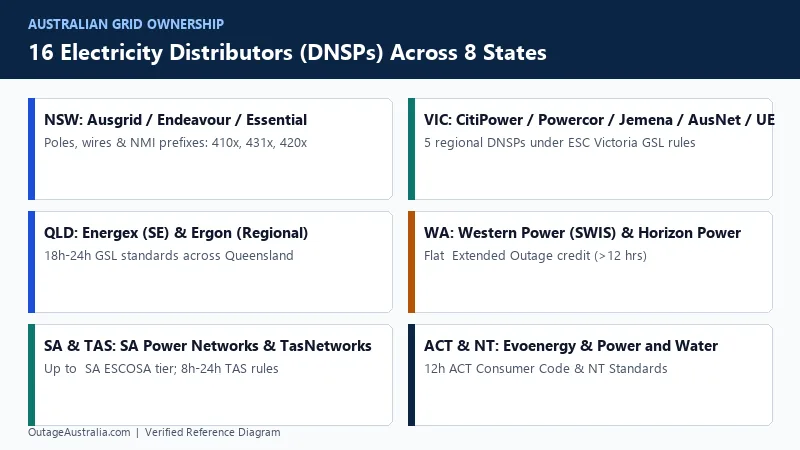
Why Deregulation Split Your Power Bill From Your Street Poles
When Australian states restructured public electricity boards into competitive markets, they divided the supply chain vertically. Dozens of energy retailers compete for tariffs on comparison sites such as Energy Made Easy, buying wholesale megawatt-hours from generators and billing your household meter. Meanwhile, physical distribution poles, underground conduits and pole fuses remained natural regional monopolies operated by a single assigned DNSP per street corridor.
You can swap retail brands tomorrow without anyone touching a ladder outside your house—yet you cannot pick a competing street distributor. Whenever a blackout extends past street boundaries, only the area DNSP tracks restoration ETAs and processes Extended Outage rebates. Resolve any Australian street in seconds on Who Is My Distributor? or scan active faults at Australia power outages.
Complete Directory of All 16 Australian Distributors Across 8 Jurisdictions
Use the reference directory below to identify every licensed electricity distributor, its footprint and its 24/7 street fault phone number:
| Jurisdiction | Electricity Distributor (DNSP) | Geographic Footprint | 24/7 Fault Line | Opening NMI Digits |
|---|---|---|---|---|
| NSW | Ausgrid | Sydney CBD, North, East, Inner West, Central Coast, Hunter | 13 13 88 | 410x |
| NSW | Endeavour Energy | Greater Western Sydney, Blue Mountains, Illawarra | 131 003 | 431x |
| NSW | Essential Energy | Regional, country & outback NSW (~95% state landmass) | 13 20 80 | 4001 / 420x |
| VIC | CitiPower | Melbourne CBD & inner ring (Carlton, St Kilda, Richmond) | 13 12 80 | 610x |
| VIC | Powercor | Western Melbourne (Hoppers Crossing 3029), Geelong, Ballarat, Bendigo | 13 24 12 | 620x |
| VIC | Jemena | North-west Melbourne (Broadmeadows, Essendon, Sunbury fringe) | 13 16 26 | 6001 |
| VIC | United Energy | South-east Melbourne & Mornington Peninsula | 13 20 99 | 640x |
| VIC | AusNet Services | Outer east/north-east Melbourne, Gippsland & eastern VIC | 13 17 99 | 630x |
| QLD | Energex | Brisbane, Gold Coast, Sunshine Coast, Ipswich, Toowoomba | 13 62 62 | 31xx / QBxx |
| QLD | Ergon Energy | Regional, coastal & far-north Queensland | 13 22 96 | 30xx / QExx |
| WA | Western Power | Perth 6000, Mandurah, Bunbury, Albany, Kalgoorlie (SWIS) | 13 13 51 | 800x / SWIS |
| WA | Horizon Power | Pilbara, Kimberley, Gascoyne, Esperance & remote WA towns | 13 23 51 | Regional WA |
| SA | SA Power Networks | Adelaide & statewide South Australia | 13 13 66 | 200x |
| TAS | TasNetworks | Hobart, Launceston & statewide Tasmania | 13 20 04 | 8000 / 8590 |
| ACT / NT | Evoenergy / Power & Water | Canberra (ACT) / Darwin, Alice Springs & NT | 13 10 93 / 1800 245 090 | 700x (ACT) |
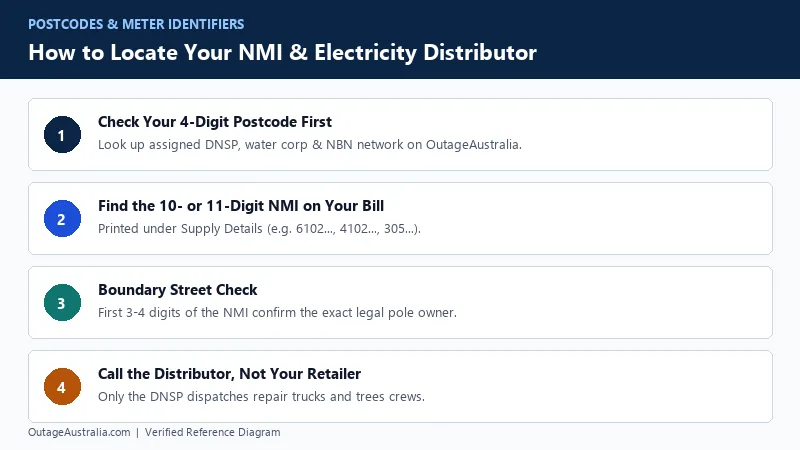
Boundary Suburbs: When One Road Splits Between Two Networks
Although 4-digit postcodes map cleanly to one distributor across roughly 98% of Australia, boundary corridors occasionally split opposing footpaths of a single avenue—for example, Inner Sydney boundaries between Ausgrid and Endeavour Energy near Parramatta River corridors, or south-eastern Melbourne pockets shared among CitiPower, United Energy and AusNet. Never guess when lodging a formal GSL outage compensation claim.
Instead, pull down any recent retail PDF invoice and scan the top supply summary box for your 10- or 11-digit NMI. Under AEMO metering allocation standards, the opening four digits uniquely pinpoint the legal distributor owning that property's meter cable.
Rural SWER Lines vs Inner-City Ring Feeds
Knowing which distributor feeds your postcode also clears up why restoration speed varies dramatically between postcodes. Dense CBD and inner-suburban distributors (CitiPower, Ausgrid metro, Energex inner Brisbane) rely heavily on underground cables linked in closed loops: control-room engineers routinely switch intact alternate routes within 15 minutes.
By contrast, outer-growth corridors and regional towns under Powercor, Essential Energy, Ergon and Western Power run long radial overhead 22kV feeders and Single Wire Earth Return (SWER) spurs crossing wooded paddocks. When summer storms or Total Fire Ban fast-trip rules interrupt a radial country spur, field trucks must physically drive and inspect kilometres of poles before safely re-closing fuses. Track your household tariff costs alongside local utility reliability on our Electricity kWh Tariff Calculator.
Apartment Embedded Networks & Strata Sub-Meters
Tenants inside modern high-rise apartment complexes, retirement villages or caravan parks sometimes encounter an embedded electricity network. Instead of connecting every flat directly to Ausgrid or CitiPower, the building owner buys bulk supply through one parent gate NMI and bills apartments via an internal sub-meter operator. Even in embedded buildings, widespread street blackouts still cut the building's parent supply—so checking your postcode outage tracker first tells your strata manager within ten seconds whether the fault sits inside the basement switchboard or down the public street. If you are unsure whether your unit sits in an embedded scheme, check your invoice footer: embedded operators print an exemption notice under the AER Retail Exempt Selling Guideline rather than a standard retail NMI tariff.
Frequently Asked Questions
Can I choose a cheaper electricity distributor like I choose a retailer?
No. Only electricity retailers compete on pricing plans; your street's physical distributor (DNSP) is fixed permanently by property address and cannot be changed.
Why does my power bill sometimes list a different company name in small print?
Retail invoices must print your local distributor's 24/7 emergency fault telephone number—usually in the "Faults and Emergencies" box near the invoice footer—separate from your retailer's customer service desk.
How can I check water, gas and NBN operators for the same postcode?
Use OutageAustralia's Who Is My Distributor tool with any 4-digit AU or NZ postcode to display assigned electricity, wholesale fibre, water corporation and natural gas networks together.