3 Ombudsman Schemes & 9 Evidence Items: How to Win TIO, EWON & AFCA Outage Claims
Turn denied GSL power rebates, broken NBN fault promises and bank outage dishonour fees into resolved settlements across Australia’s three free statutory ombudsmen.
Most Australians abandon genuine outage claims after hitting their second scripted call-centre brick wall—accepting an unjustified "major weather exclusion" from an energy network, shrugging off two weeks of unpaid broken NBN sync, or absorbing a A$35 bank dishonour fee triggered by an Osko failure. Yet Australian law backs every residential and small-business customer with three powerful, completely free external dispute schemes. Putting together a concise, chronological utility outage complaint backed by nine verifiable pieces of evidence turns a brushed-off phone call into a formal case that operators pay progressive fees to settle fast.
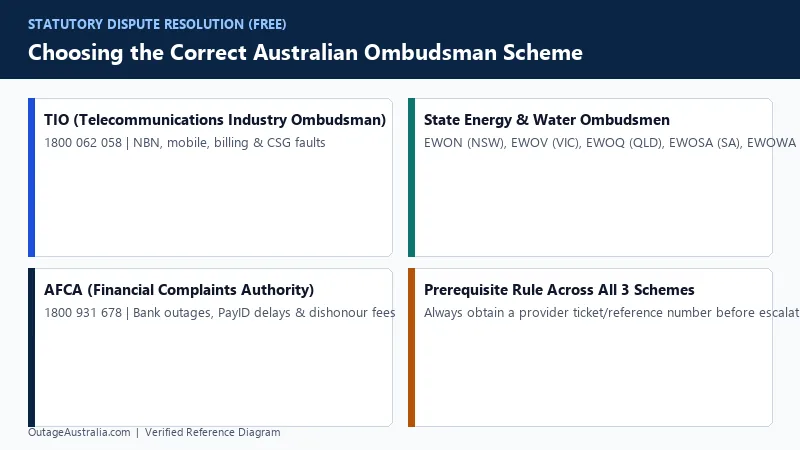
Comparing Australia's 3 Statutory Ombudsman Schemes
Each essential infrastructure sector assigns an independent dispute body funded by member providers—always 100% free for consumers and small businesses:
| Ombudsman Scheme | Free Hotline & Portal | Disputes Covered | Typical Stage-1 Resolution |
|---|---|---|---|
| TIO (Telecommunications Industry Ombudsman) | 1800 062 058 | NBN, Opticomm, mobile tower outages, missed technician windows & pro-rata credits (tio.com.au) | 5–15 business days |
| State Energy & Water Ombudsmen (EWON, EWOV, EWOQ, EWOSA, EWOWA) | 1800 246 545 (NSW) 1800 500 509 (VIC) |
Unpaid GSL power rebates, voltage-surge appliance claims, water main rebates (ewon.com.au) | 10–25 business days |
| AFCA (Australian Financial Complaints Authority) | 1800 931 678 | Retail bank outages, PayID/Osko stalls, double debits & dishonour fee reversals (afca.org.au) | 10–21 business days |
The Mandatory First Rule: Give Your Provider One Formal IDR Chance
No Australian ombudsman opens a case straight off the bat if the network, telco or bank has never had a logged opportunity to fix it internally. Phoning a casual support agent rarely triggers formal review unless you explicitly instruct the desk: “Please log this as a formal Internal Dispute Resolution complaint and send my reference number by email.”
Allow 5 to 10 business days for an internal written reply (keeping your outage hours verified via our Outage Compensation Calculator and your operator verified via Who Is My Distributor?). The moment that deadline lapses—or an unsatisfactory refusal arrives—escalate externally.
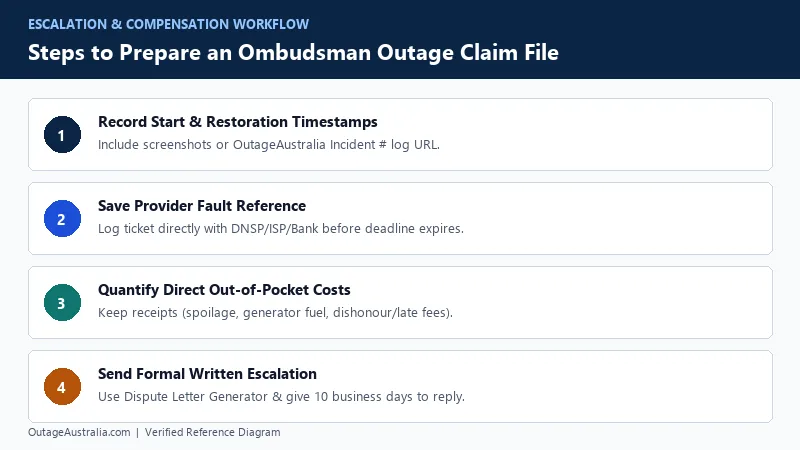
9 Evidence Items That Make Outage Claims Undeniable
Ombudsman investigators resolve cases on documented proof rather than emotion. Collect these nine items into a single PDF before lodging:
- Start & Restoration Timestamps: Exact local times from DNSP SMS alerts or OutageAustralia archived incident URLs.
- Meter or Account Numbers: Your 10/11-digit electricity NMI, retail ISP account ID, or bank BSB/merchant terminal number.
- Internal Ticket Numbers: Every dated support chat transcript or email proving when you alerted the operator.
- Timestamped Hardware Photos: Red Optical LEDs on NBN boxes, smart-meter blank displays or bank app errors showing your device clock.
- Missed Technician Logs: SMS booking windows where crews or NBN contractors never showed up.
- Written Electrician / Repair Reports: Vital for fridge, HVAC or solar-inverter surge claims—linking failure explicitly to a voltage surge or phase-neutral break rather than age wear.
- Itemised Out-of-Pocket Invoices: Dated receipts for replacement mobile data, backup fuel or third-party bank dishonour charges.
- Neighbour Confirmation: Simple confirmation whether adjacent properties shared the exact fault, proving external street origin.
- Specific Dollar Remedy Sought: State the exact credit, fee refund or repair sum requested on page one.
Why Case Fees Make Operators Settle Rapidly at Stage 1
Behind the scenes, TIO, EWON/EWOV and AFCA bill tiered case-management fees straight back to the telco, distributor or bank every time a complaint climbs past initial referral. Because paying A$400+ in escalated scheme administration fees costs far more than crediting a rightful A$140 GSL rebate or A$95 ISP credit, senior specialist teams normally settle clear, well-documented files within days of receiving an ombudsman notice. Build a crisp chronological letter ready for your provider or ombudsman using our Complaint Letter Generator.
What Ombudsmen Will—and Will Not—Award
Keep expectations grounded on statutory boundaries so your claim stays sharp: schemes readily enforce statutory GSL tiers, pro-rata plan credits, verified equipment repair invoices and reversed bank dishonour fees, whereas speculative claims for general inconvenience or uninvoiced lost income rarely pass formal determination. Remember two quick timing tips before pressing submit: always attach a plain 10-line timeline cover note rather than dumping 40 unlabelled screenshots, and check strict statutory windows (Western Power Extended Outage claims expire at 60 days; AFCA and TIO allow generous months/years post-IDR reply, yet fresh logs settle fastest). Best of all, ombudsman decisions bind the provider if you accept—yet remain non-binding on consumers, leaving your full legal rights under Australian Consumer Law intact.
3-Phase Resolution Timeline After You Lodge Online
Most clear outage disputes settle far faster than households fear once an independent case file opens:
- Days 1–5 (Executive Complaint Referral): The scheme pushes your file directly past frontline call centres straight to the distributor, bank or telco's specialist resolutions team. Straightforward GSL credits, bank dishonour fee refunds and pro-rata NBN credits routinely approve right here inside 10 business days.
- Weeks 2–5 (Independent Conciliation): Where facts sit contested—for instance, whether a storm qualified for a regulatory Major Event Day exemption or whether neutral voltage surges ruined household whitegoods—an independent case officer examines NMI interruption logs and electrician diagnostics before brokering settlement.
- Formal Determination (Rare Cases): Where providers still dig in against verifiable losses, the ombudsman can issue a binding monetary determination requiring immediate bill credit or direct bank payment—compelling operators to close your account discrepancy cleanly without going near a small-claims tribunal.
Frequently Asked Questions
Does lodging a TIO, EWON or AFCA complaint cost anything?
Never. All Australian statutory consumer dispute schemes are 100% free for residential households and eligible small businesses—even if your case proceeds past initial referral into multi-week conciliation and formal written determination.
What if my electricity distributor blamed "severe weather" for a 16-hour blackout?
Request their formal regulatory Major Event Day exclusion confirmation; routine storms or equipment failures often remain eligible for GSL credits even when frontline staff cite bad weather.
Can small businesses also use TIO, AFCA and state energy ombudsmen?
Yes—small business accounts meeting each scheme's annual consumption or turnover thresholds qualify on the exact same fee-free footing as households.